
Prisoner Transport Upfitting: Safety Specs Texas Agencies Shouldn’t Skip
A prisoner transport vehicle is not simply a patrol vehicle with a partition added behind the front seats. It must manage a different set of risks: secure separation, occupant protection, climate control, sanitation, monitoring, emergency access, and resistance to tampering.
For Texas agencies, those requirements become even more important during long transports across rural counties and summer operations in extreme heat. A well-planned build supports officer safety and detainee welfare without compromising the vehicle’s factory safety systems.
Texas Government Code §500.006 directs the state to establish policies for the safe transfer of inmates, while local agencies and purchasing departments typically define the practical vehicle requirements through policies, bid specifications, and operational needs. That makes a vehicle-specific design review essential before equipment is ordered.
How Prisoner Transport Upfitting Differs From a Patrol Build
A standard patrol vehicle is designed around the officer’s workspace. The upfit typically prioritizes emergency lighting, communications, weapon access, computer placement, and efficient control of onboard electronics.
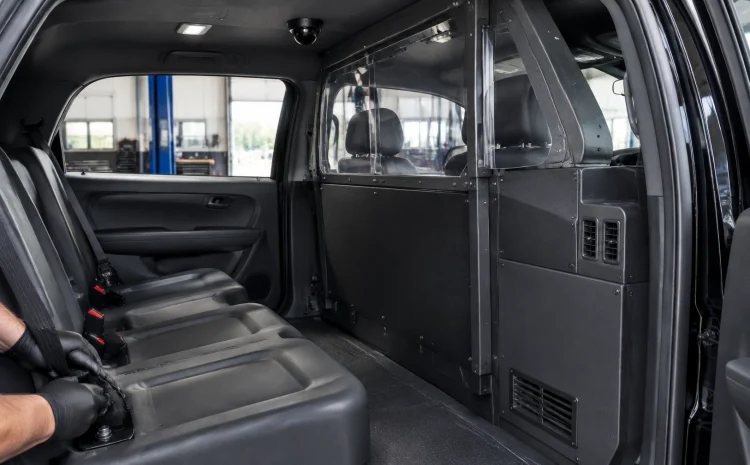
A transport vehicle adds a second operational environment behind the officer: a compartment that must remain secure, observable, cleanable, and reasonably comfortable throughout the trip. The partition, rear seating, restraints, locks, ventilation, cameras, and interior surfaces all have to work together.
That changes the design process in several ways:
- Equipment must not create reachable footholds, sharp edges, or loose components.
- Seat and restraint mounting must account for occupant protection and crash loads.
- Rear climate control must work during extended periods in a hot vehicle.
- Cameras and microphones must monitor the compartment without becoming easy targets for tampering.
- Wiring must be protected from cleaning chemicals, abrasion, and detainee access.
- Front-cabin equipment must not interfere with the partition or factory airbag deployment zones.
This is why prisoner transport work should be treated as a dedicated form of law enforcement vehicle customization, not an add-on to a conventional police package.
Partition and Barrier Specifications Matter
The partition is the primary physical boundary between the front and rear compartments. Its design should be selected for the specific vehicle model, seating layout, airbag configuration, and expected transport use.
Materials, structure, and visibility
Common transport designs use a rigid steel or reinforced framework combined with impact-resistant polycarbonate or similar transparent panels. Some vehicles use mesh or caged sections, while others use solid molded or composite modules.
There is no single partition rating that applies to every Texas agency or vehicle. Instead, fleet managers should ask for documentation covering:
- The partition’s material and construction.
- The intended vehicle make, model, and model year.
- Mounting locations and structural attachment points.
- Compatibility with front and side airbag systems.
- The condition of visibility panels after repeated cleaning and use.
- Any manufacturer testing or installation limitations.
A partition should provide reliable separation without unnecessarily reducing front-seat travel, rear-compartment space, or visibility. If a camera is mounted behind the partition, the design also needs to prevent the barrier frame from blocking the view.
Rounded edges and anti-tamper construction
The rear compartment should avoid exposed sharp corners, protruding fasteners, and unprotected brackets. Rounded-edge trim and covered transitions reduce injury risks and make the interior easier to clean.
Tamper-resistant fasteners can help protect access panels, camera housings, vents, and door-control covers. They should not make routine inspection impossible, however. Authorized technicians still need a practical way to service components without dismantling the entire compartment.
Restraints Need Proper Structural Mounting
A seat belt is only as dependable as its mounting points. In a transport build, the seating, belt anchors, floor structure, partition, and surrounding panels must be considered as one system.
Agencies should confirm:
- Each seating position has the correct restraint arrangement for the vehicle and transport module.
- Belt anchors are mounted to appropriate structural points rather than thin trim or unsupported panels.
- Seat and belt hardware does not create accessible edges or loose loops.
- The layout supports safe loading and unloading.
- The system remains compatible with the vehicle’s factory restraint and airbag systems.
Agency policies may also address the use of handcuffs, waist chains, leg restraints, and seat belts. Vehicle hardware should support those policies without creating a reason to attach a person directly to a partition, floor post, or other vehicle component.
The final configuration should be checked for belt access, buckle placement, seating posture, and interference from the partition or console. A restraint that is technically present but difficult to use correctly is not a successful upfit.
Console Design Must Work With the Partition
A hard-mounted console and a slip-in console serve different purposes. A hard-mounted console generally provides a more stable installation for radios, siren controls, computers, storage, or other equipment. A slip-in console may offer easier removal or reconfiguration when vehicles are rotated through a fleet.
Neither option is automatically right for a prisoner transport vehicle. The choice depends on the front-cabin equipment plan and how the console interacts with the partition.
A console should not:
- Reduce the officer’s ability to exit quickly.
- Block a partition door or access point.
- Create a gap that exposes wiring or mounting hardware.
- Interfere with knee airbags, side airbags, or other deployment zones.
- Become a projectile because it is inadequately secured.
- Restrict visibility into the rear compartment.
Secure weapon storage and gear compartments should be placed where officers can reach them without giving a detainee access through the partition. Long equipment, loose tools, and spare restraints should have dedicated retention points rather than being left in open areas.
Climate Control Is a Safety Feature in Texas
Heat management is not a comfort upgrade for Texas prisoner transport vehicles. It is a core operational consideration.
A vehicle may spend significant time idling at a courthouse, jail, hospital, or roadside location. It may also cover long distances between rural counties. The rear compartment can become substantially hotter than the front cabin, particularly when barriers limit airflow or the vehicle is stopped in direct sunlight.
The design review should address:
- How conditioned air reaches the rear compartment.
- Whether vents can be tampered with or blocked.
- Whether airflow is sufficient for each seating area.
- How the system performs while idling.
- Whether auxiliary fans or dedicated ventilation are appropriate.
- How the installation affects the factory HVAC system.
- Whether rear temperature and airflow can be checked during inspection.
Passive vents alone may not be enough for every application. The correct solution depends on the vehicle, compartment size, transport duration, and agency operating conditions.

Cameras and Audio Should Be Observable but Protected
A transport camera should provide a useful view of the entire compartment without being placed where it can be easily blocked, struck, or disconnected. Common considerations include the camera’s height, lens angle, lighting conditions, and visibility around partitions or divider walls.
Audio equipment also requires careful placement. A microphone should capture useful communication without leaving an exposed cable, connector, or housing within reach.
Agencies should define:
- Which areas must be visible.
- Whether separate cameras are needed for multiple compartments.
- Where the recording equipment is stored.
- How audio is captured and reviewed.
- How door-open or emergency alerts are handled.
- How wiring and connectors are protected during cleaning.
Camera placement should be checked with the actual seats occupied and the doors closed. An empty-compartment test can miss blind spots created by a passenger’s position or by a divider.
Door Lock-Out and Emergency Egress Need a Clear Plan
Rear doors and windows should prevent unauthorized operation from inside the detainee compartment while still allowing officers to manage loading, unloading, and emergencies.
The upfit review should include:
- Rear door lock-out or control protection.
- Window-control deactivation or shielding where applicable.
- Reliable exterior handles and latches.
- Slam-latch operation and door-closed confirmation.
- A defined emergency egress method.
- Access for medical response when necessary.
- Inspection points for locks, hinges, latches, and release hardware.
Emergency egress cannot be treated as an afterthought. A secure compartment still needs a documented method for opening the vehicle if the normal controls fail, the vehicle is involved in a collision, or a medical emergency develops.
Sanitation and Easy-Clean Surfaces Reduce Downtime
Prisoner transport interiors need to be cleaned frequently. Porous upholstery, exposed seams, carpet, and difficult-to-reach recesses can increase cleaning time and allow contamination to build up.
Durable transport interiors commonly favor non-porous seating and panels, sealed transitions, and surfaces compatible with the agency’s approved cleaning products. The upfit should also limit gaps around seat bases, vents, camera housings, and door hardware.
During a design review, inspect:
- Seat-to-wall and seat-to-floor transitions.
- Drainage and fluid collection points.
- Door thresholds and corners.
- Vent and camera housings.
- Areas beneath benches or molded seats.
- Access to removable panels for inspection.
Easy cleaning should not come at the expense of structural security. Panels still need to be firmly mounted and protected against prying or repeated impact.
Protect the Factory Wiring and Airbag Systems
Added equipment should use a separate, clearly identified harness with suitable over-current protection and abrasion protection. In detainee-accessible areas, wiring should be routed behind secure panels or inside protected channels. There should be no exposed harnesses, dangling connectors, or easily pulled cable loops.
Most importantly, the upfit should follow OEM-approved install procedures. Factory wiring, airbag sensors, restraint systems, and control modules are not convenient places to make shortcuts.
Tampering with those systems can affect crash sensing, deployment timing, warning indicators, or the vehicle’s compliance with applicable safety requirements. Upfitters should not relocate or alter airbag sensors, SRS wiring, or control modules unless the vehicle manufacturer’s written procedure specifically permits the work.
When installations take place near SRS components, the system should be handled according to the applicable OEM service and body-builder guidance, then checked after completion. Added equipment must also remain outside airbag deployment paths and avoid attaching hardware to sensor mounts or factory restraint components.
A Practical Review Before Ordering Equipment
Before approving a prisoner transport build, Texas fleet managers should review the complete vehicle as a system:
- Confirm the agency’s transport policy and any applicable bid specifications.
- Match the partition, seats, restraints, and door hardware to the exact vehicle.
- Review HVAC performance for summer heat and long rural runs.
- Define camera, audio, recording, and emergency-alert requirements.
- Confirm storage locations for weapons, medical supplies, and loose equipment.
- Verify cleanability and access for inspection.
- Require protected wiring with no detainee-accessible harnesses.
- Document OEM compatibility around airbags, seat belts, and factory electronics.
- Test the finished vehicle with doors closed, seats occupied, and equipment secured.
Build for the mission, not just the delivery date
A transport unit has to remain secure and functional after repeated loading cycles, cleaning, heat exposure, vibration, and long-distance use. That requires more than installing individual products. It requires coordinated planning between the vehicle platform, partition, restraint system, electronics, climate control, and agency procedures.
Signal Fleet Solutions provides professional police vehicle upfitting and specialty fleet customization for Texas law enforcement and municipal fleets. To discuss a prisoner transport SUV, van, or dedicated transport unit, contact the Signal Fleet Solutions team for a vehicle-specific upfit review.